WORKBENCH
How effective are Noch’s latest Gras-Master 4.0 tools? Peter Marriott road-tests these innovative devices and compares them to their predecessor.
PHOTOGRAPHY: PETER MARRIOTT
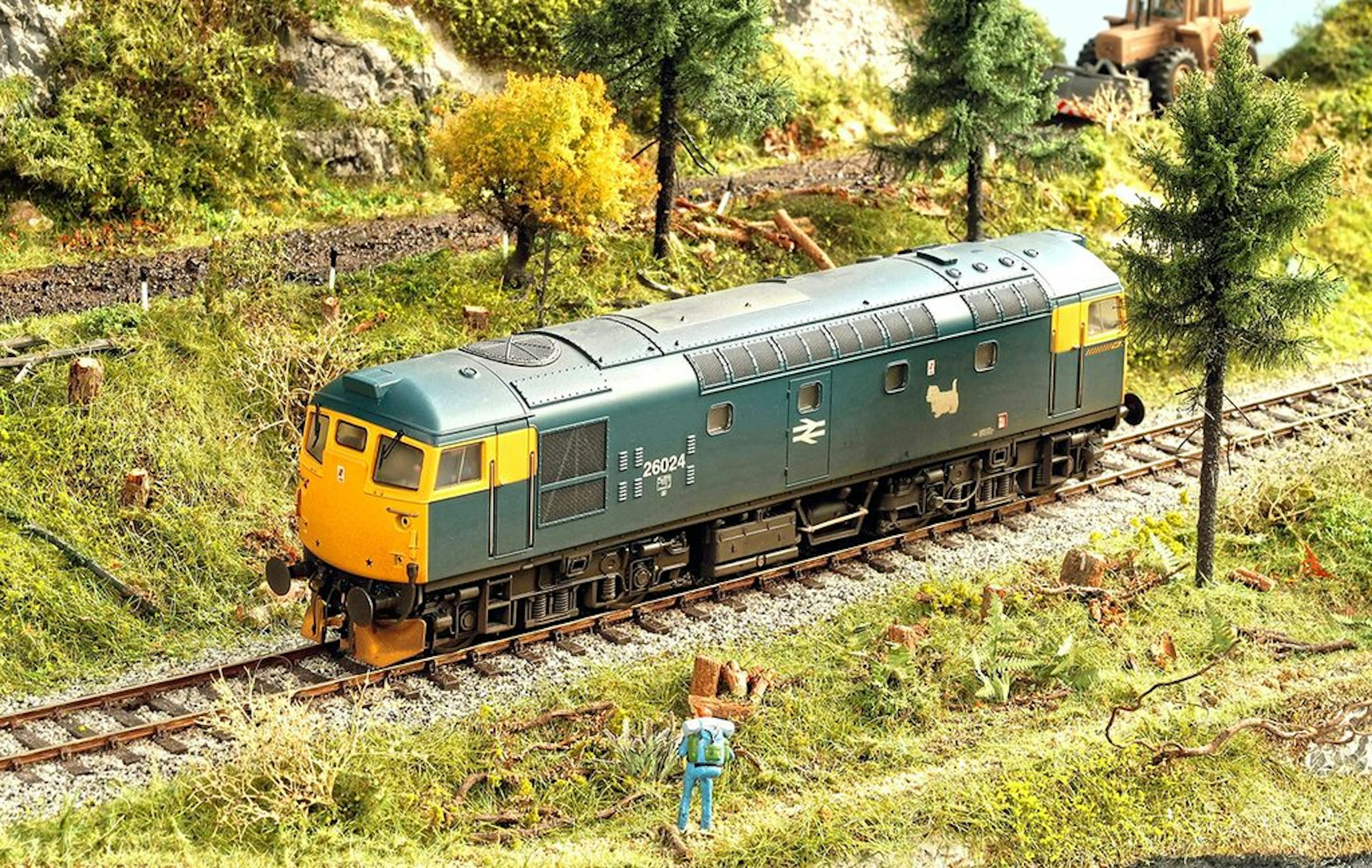
Electrostatic grass adds authentic texture to scenic areas, especially when used in conjunction with other products, such as poly fibres and foam bushes.

Last year marked the 20th anniversary of Noch’s electrostatic grass planting tools and, to celebrate the milestone, the German manufacturer launched two new products: the Gras-Master 4.0 and Gras-Master 4.0 PROFI.
Both tools are now rechargeable, in contrast to the previous need for a 9V or several AA batteries. Instead, a separate cable is supplied with a USB-C port fitted to the tool and a USB-A connector for a power source, which is not supplied. Suitable USB power packs are available from Amazon and several other retailers.
After testing both products extensively over the past year, I thought it would be useful to share my experiences. But first, for those new to the chat, here’s a summary of how electrostatic grass-planting tools work…
The system employs a hand-held electronic device that creates a high-voltage electrostatic field between the tool and the scenery. The baseboard surface needs to be linked to the tool in order to complete the necessary circuit, so a grounding clip and wire are provided, which can be attached to a nearby rail or, preferably, a steel nail temporarily inserted into the scenic base. It helps if this nail is driven into an area of wet PVA glue.
A selection of plastic grass fibres (available in many different colours and lengths) is placed inside the tool and, when power is switched on, they become energised with a static charge. Gently shaking the tool over the prepared scenic area, which has been covered in a layer of wet adhesive, allows the fibres to pass through a metal sieve screen, which prevents clumping and allows the ‘grass’ to land in an upright fashion, thanks to the electrostatic polarity between the tool and the base.
The results can look spectacular, especially when various fibre shades and lengths are blended. It’s certainly a far cry from the coloured sawdust of yesteryear, and much less hassle than dealing with teddy bear fur and other similar materials.
KEY UPDATES
The rechargeable feature is certainly an improvement over earlier battery-operated tools, and I find it takes around 3-4 hours to achieve a full charge from empty. There’s a handy LED on the base of the tool to alert the user if the power is flagging. It shows red when the charge is failing and green when fully juiced up and ready for use.
The Gras-Master 4.0 generates around 15kV of static charge, while the Gras-Master 4.0 PROFI has an adjustable output of between 11-20kV, controlled via a dial on the base of the tool. In comparison, the battery-operated Gras-Master 3.0 generates a maximum of 11kV.
The new tools have a useful stand built into the body so they can be stood safely on the workbench, removing the risk of them rolling off onto the floor. One of my earlier Gras-Masters did just that, so I can see this is a worthwhile change.
Earlier Noch Gras-Masters featured a single built-in fibre container, fixed to the top of the tool. This meant that the interchangeable sieve covers (which separate the fibres as they fall out of the tool) needed to be removed from the container before the fibres could be topped up or changed.
Now, the containers themselves are designed to twist on and off the tool, allowing them to be filled on the workbench, making the job less fiddly. It also raises the possibility of loading several containers with fibres of varying lengths and colours, which can be switched over as necessary, speeding up the treatment of larger areas. Of course, such a strategy would require buying a few extra containers (only one is supplied), but it’s worth considering if you – or your club – are working on larger layout projects.
As is common with these tools, both Noch Gras-Master 4.0 devices feature a cable and crocodile clip to connect to the baseboard to complete the necessary ‘circuit’, allowing the electromagnetic field to be created. Usefully, this cable is now red, which differentiates it from the black charging cable. The cable is very flexible and less unwieldy compared to the ones fitted to earlier tools, and I found it easier to work with.
Additionally, there are now detailing accessories plus a fibre container for dealing with large areas of grass. So, this can be seen as a whole new grass planting range, rather than just another updated tool. In fact, it represents a significant step-change for Noch’s Gras-Master system, one of the biggest since its introduction in 2005.
TESTING THE TOOLS
I pitted the new Noch Gras-Master 4.0 and 4.0 PROFI against the previous 3.0 device, in each case using a blend of Woodland Scenics 4mm, 7mm and 12mm grass fibres, planted into Woodland Scenics Static-Tac adhesive, which is specially formulated for this purpose. I chose not to evaluate the tools with 2mm grass fibres, because any tool would plant these short fibres easily.
All of the tests were done within 30 minutes of each other, and the adhesive was painted onto pieces of cardboard at the same time to make the tests as fair as possible.
HOW DID THEY COMPARE?
On a full charge, the Gras-Master 4.0 can plant grass for up to 4 hours continuously. The tool has a simple on/off switch, and the device worked well with 4mm and 7mm grass fibres, although it didn’t do quite as well as the PROFI tool with 12mm fibres.
That said, I have still to find any electrostatic grass planting tool that plants 12mm fibres satisfactorily. In my experience, these long fibres tend to droop once planted and, in truth, I tend to avoid using them wherever possible. I find it much better to build up multiple layers of shorter grass fibres, which tend to perform better.
The Gras-Master 4.0 PROFI can plant grass for between 3 and 10 hours, depending on the voltage setting. The rotary voltage switch is easy to operate, and I tested the PROFI tool using 7mm fibres with low, medium and high settings. On the high (20kV) power setting, the fibres clearly performed better than on the lowest (11kV) position, with the more intense electrostatic field ensuring more of the fibres stood upright. Indeed, the fibres audibly sizzled and zinged as they left the sieve on full power!
In contrast, my older Gras-Master 3.0 (released in 2020) uses eight 1.5Volt AA-type batteries and is not rechargeable like the two other tools. Compared to the other two models, it performed poorly, with very few of either the 7mm or 12mm fibres standing vertically once the adhesive had dried. That said, the batteries were some months old, but replacing eight AA batteries at a time is not that cheap.
DECISIONS, DECISIONS…
Although around £80 more expensive than the regular Gras-Master 4.0, a model club or professional layout builder may find the 4.0 PROFI kit preferable, thanks to the overall package, which includes a standard interchangeable fibre container, plus a larger (XL) flock container and a Detail Flocker, each of which has matching sieves (coarse, medium, fine) for different grass fibre lengths. The PROFI kit also comes with a handy carry bag providing easy transportation and storage of the tool and various components. Flock Change Containers are available separately for both the Gras-Master 4.0 and 4.0 PROFI (product ref. 60127, £21.50), complete with bayonet locks for quick changes between fibre colours and sizes. The transparent container allows the user to keep an eye on how much material remains and comes with three sieves for different fibre lengths.
The Gras-Master 4.0 Detail Flocker add-on unit (ref. 60128, £32.50) is also available separately, along with the XL Flock Container (ref. 60129, £38.00), as provided with the 4.0 PROFI set. The Detail Flocker is great for reaching into awkward corners of a layout or between structures and trees, while the large capacity of the XL container reduces the need to keep refilling the device when treating larger areas.
Another Noch accessory worth considering is the set of Grass Stamps (ref. 60137, £32.50), supplied as a pair: one large and one small, plus an adhesive tray in which to dip them. The idea is to create random patches of wet glue on the surface, into which grass fibres can be planted, thus avoiding an overly uniform appearance. Noch’s range is available from most model shops and online retailers and, with a bit of shopping around, savings can be made on the standard retail prices.
A sizeable investment for modellers they may be, but Noch has poured two decades’ worth of research and development into their latest generation of electrostatic grass planting tools – and it shows.
What you will need
SHOPPING LIST
◆ Noch 60120 Gras-Master 4.0
Price: £205.00
◆ Noch 60125 Gras-Master 4.0 PROFI
Price: £285.00
Availability: Noch stockists or Gaugemaster
Web: www.noch.com, www.gaugemasterretail.com
STEP BY STEP
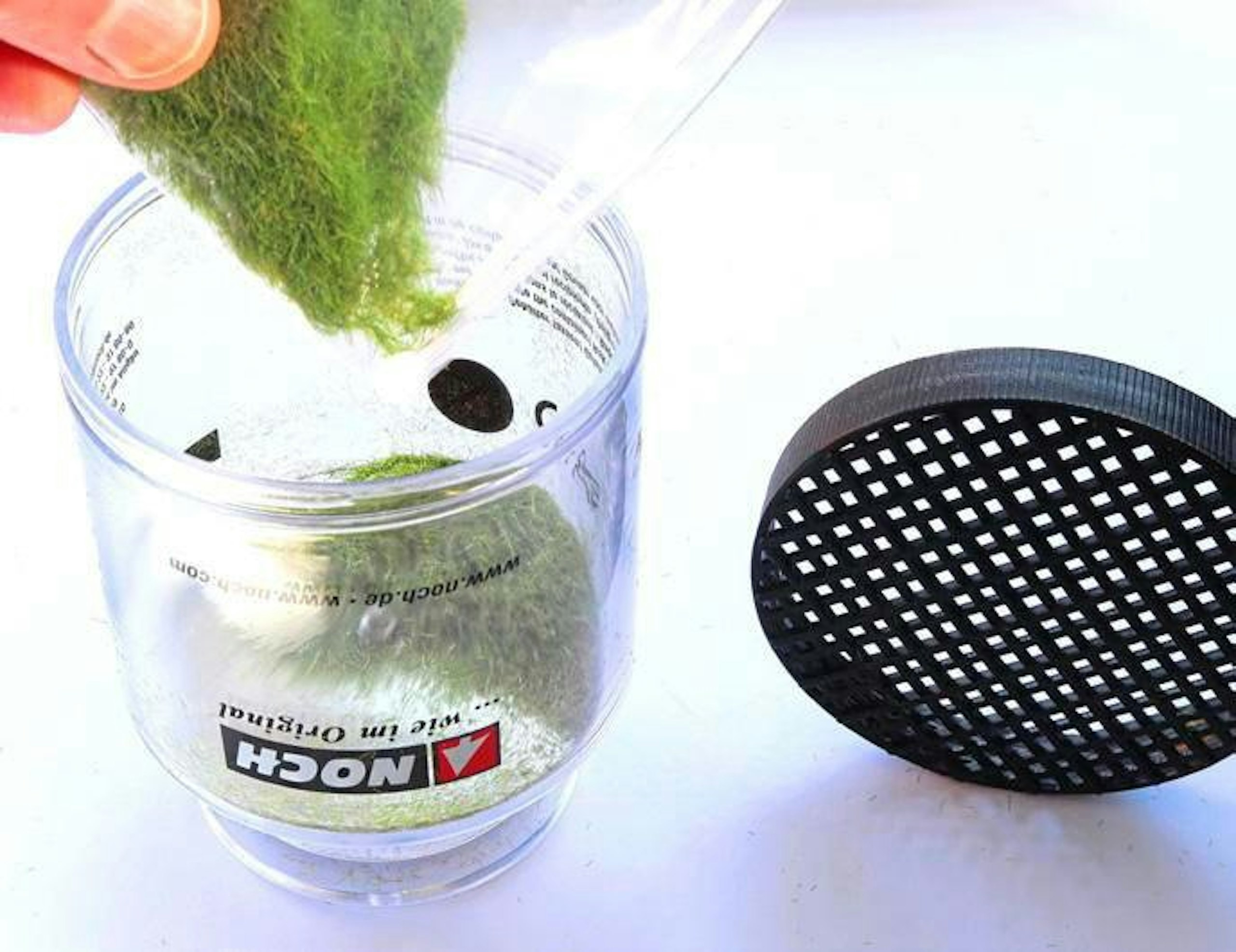
1 The new Noch tools feature interchangeable grass fibre containers. Two different sizes are supplied with the 4.0 PROFI, and a single container is supplied with the 4.0 tool.
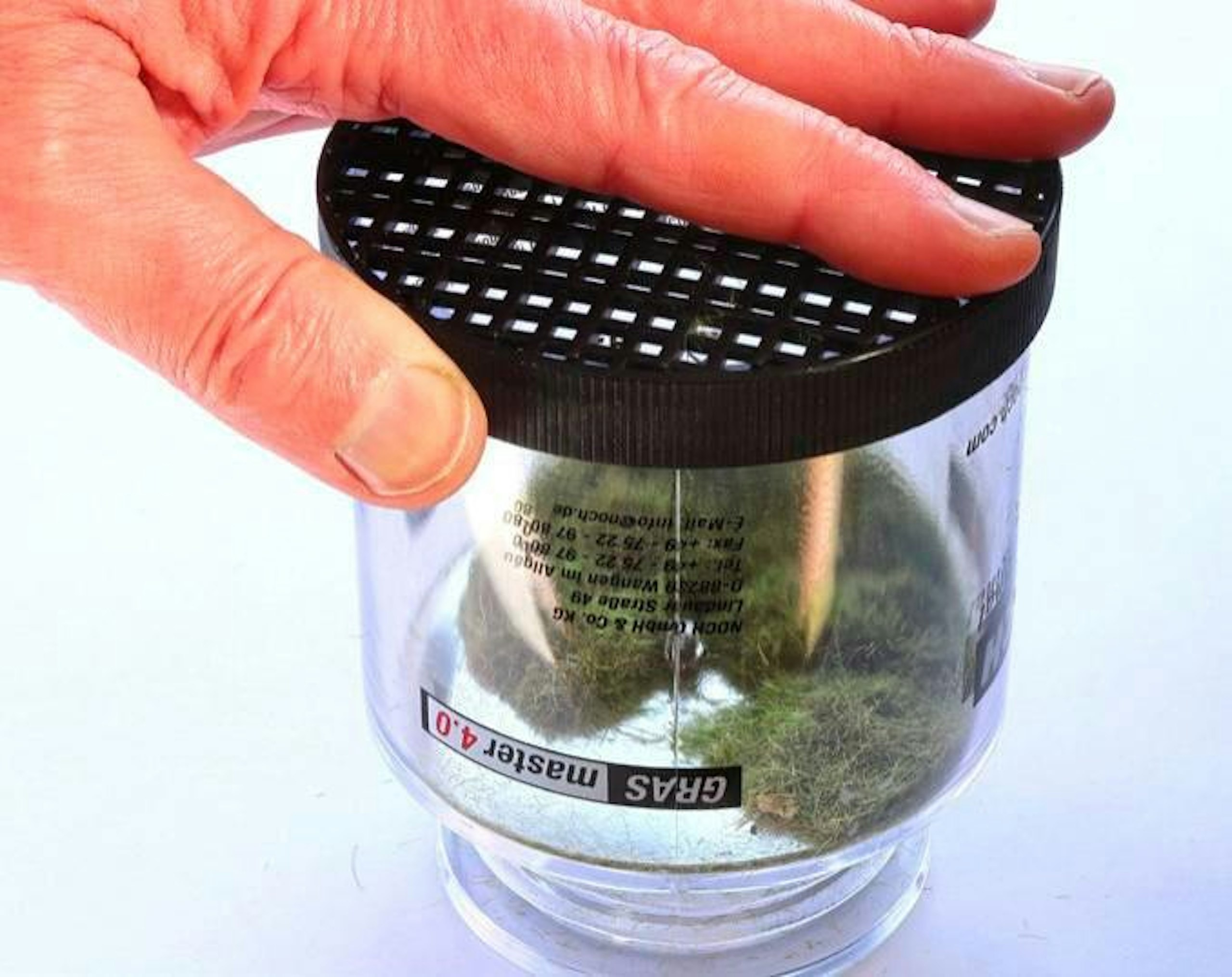
2 Here, the container has been filled with 4mm grass fibres before the appropriate sieve filter is attached. I’ve used the medium-sized sieve. The sieves are a simple screw fit.
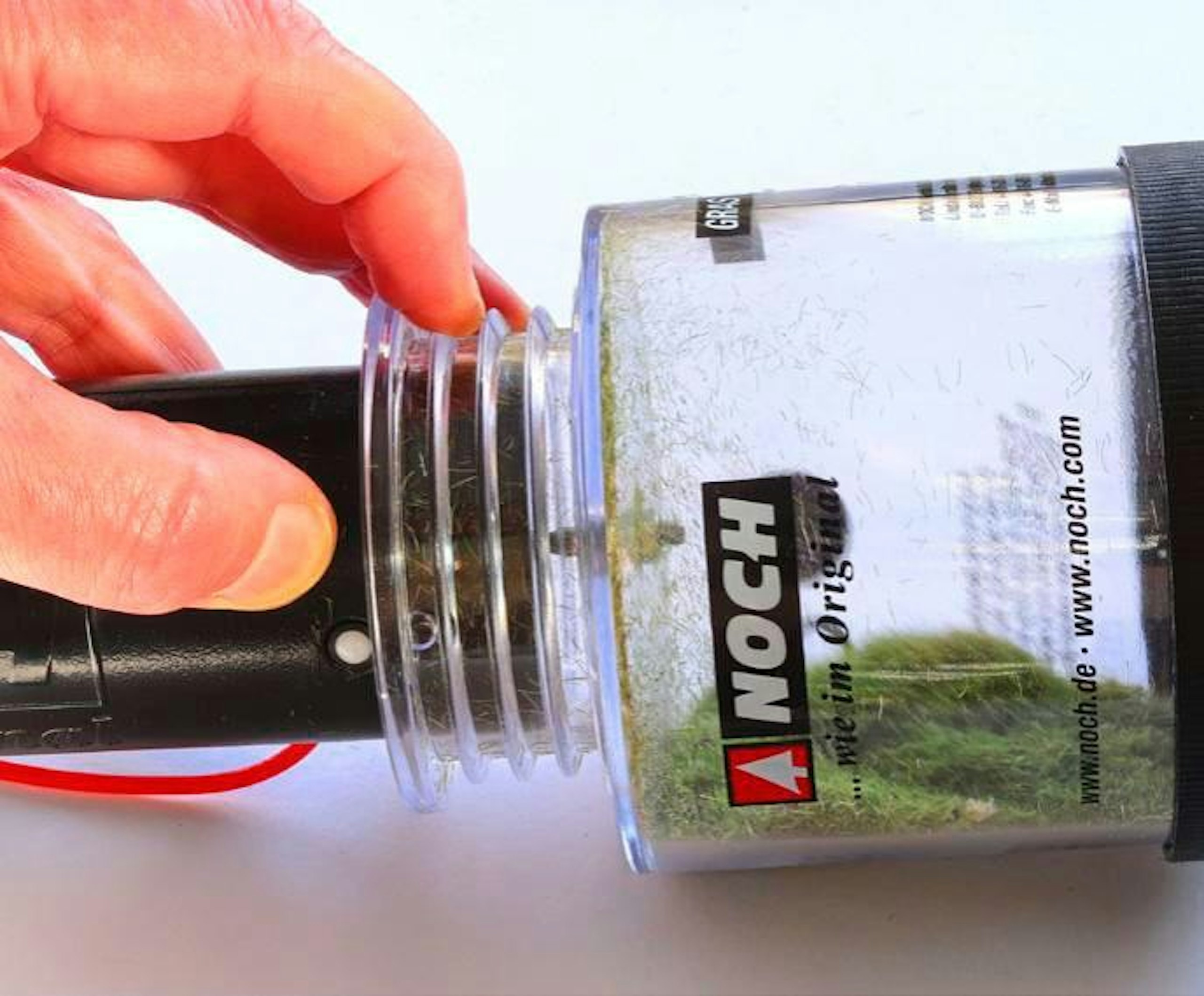
3 The containers slot into place in the main device with bayonet-style fittings. Two white ‘pips’ on the stem of the tool must align with two dimples on the grass fibre container.
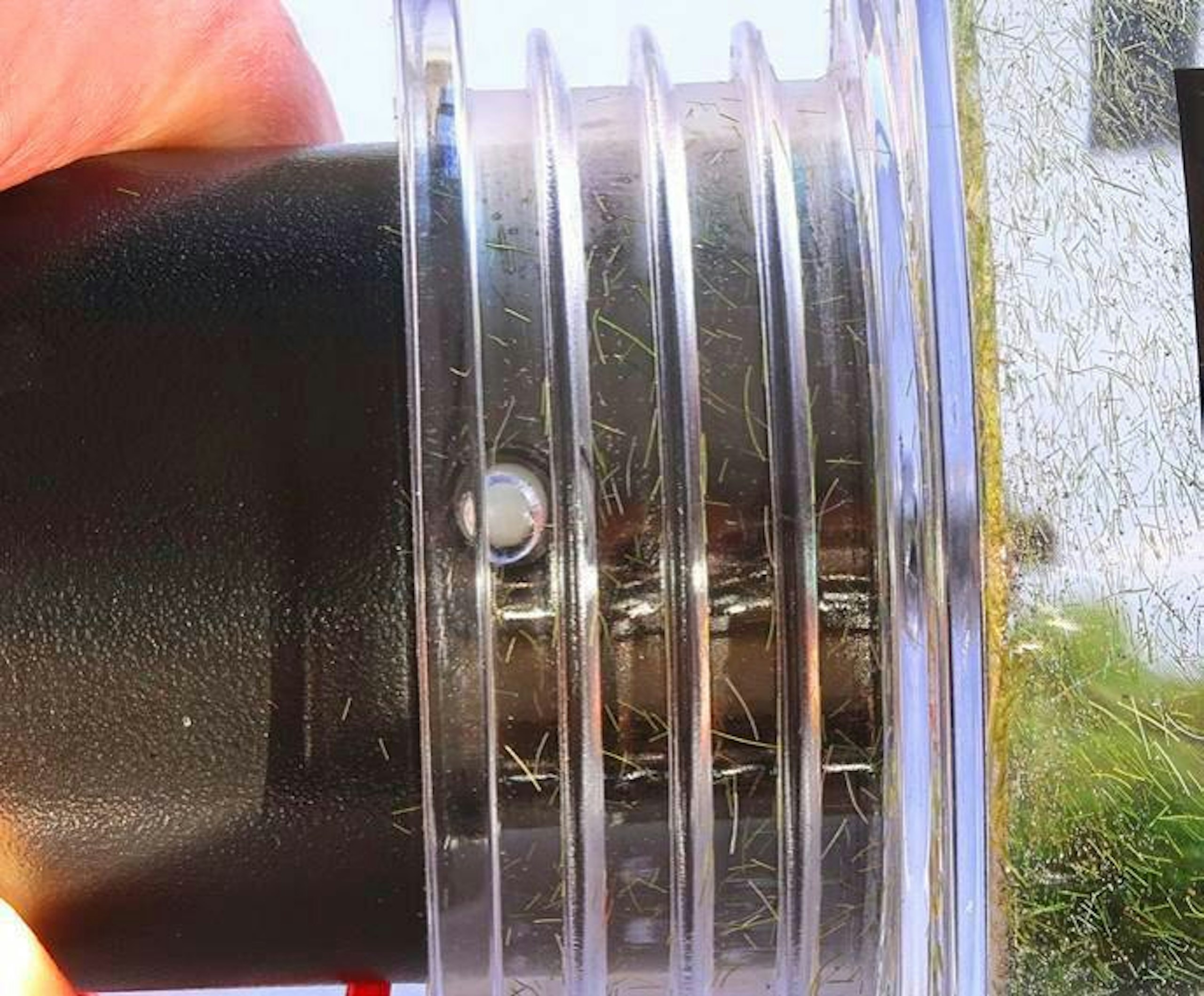
4 Here, the grass carrying container is firmly fixed to the tool with the white ‘pip’ in position holding the container in the correct spot ready to plant grass fibres.
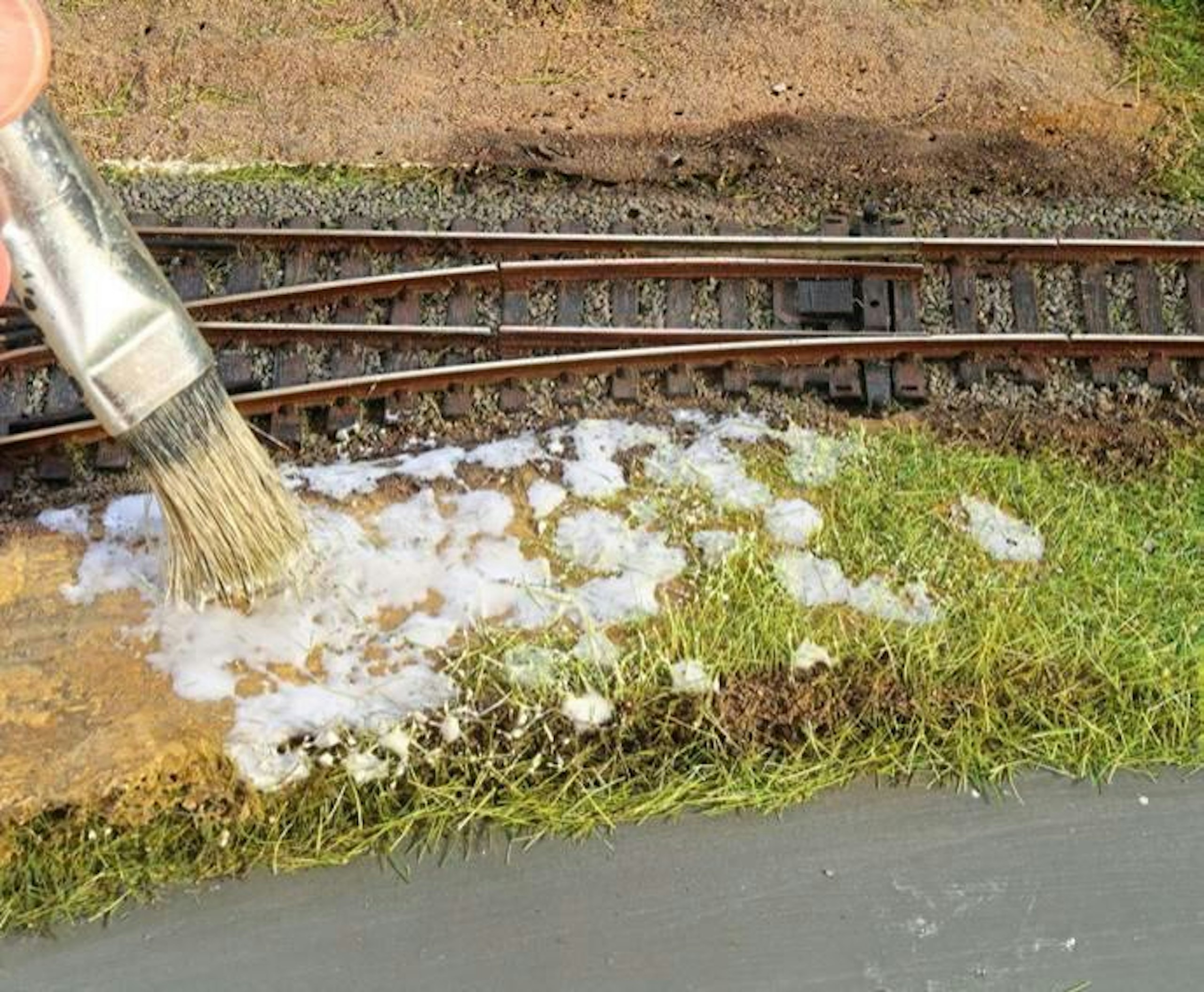
5 Applying a little grass glue to the landscape. It is better not to paint glue over the entire surface to create patchy, more realistic looking grass and weeds.
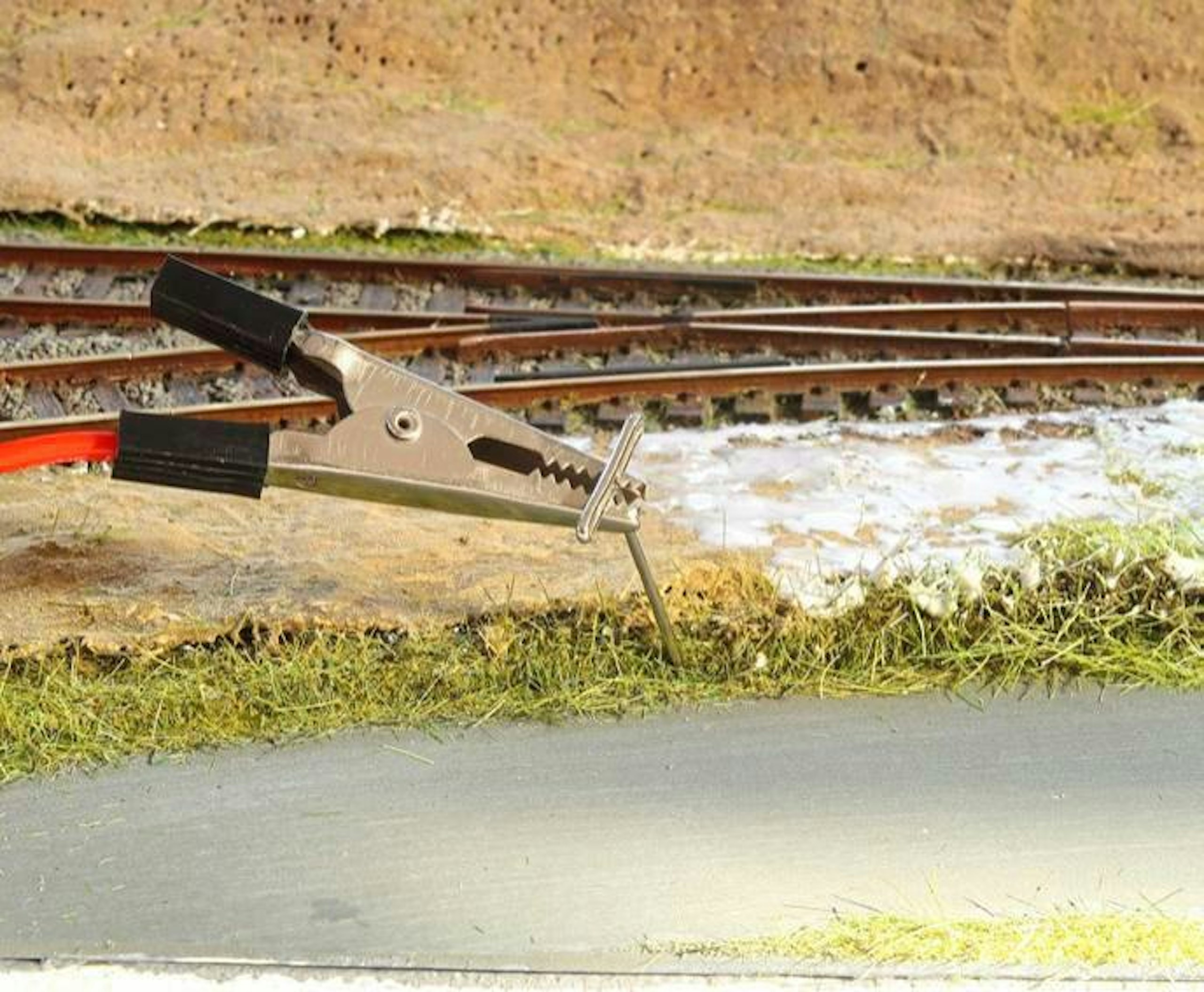
6 Attaching the alligator clip on the tool to a steel nail located near the wet PVA-type glue. This helps to create the necessary circuit, allowing the electrostatic grass to be planted effectively.
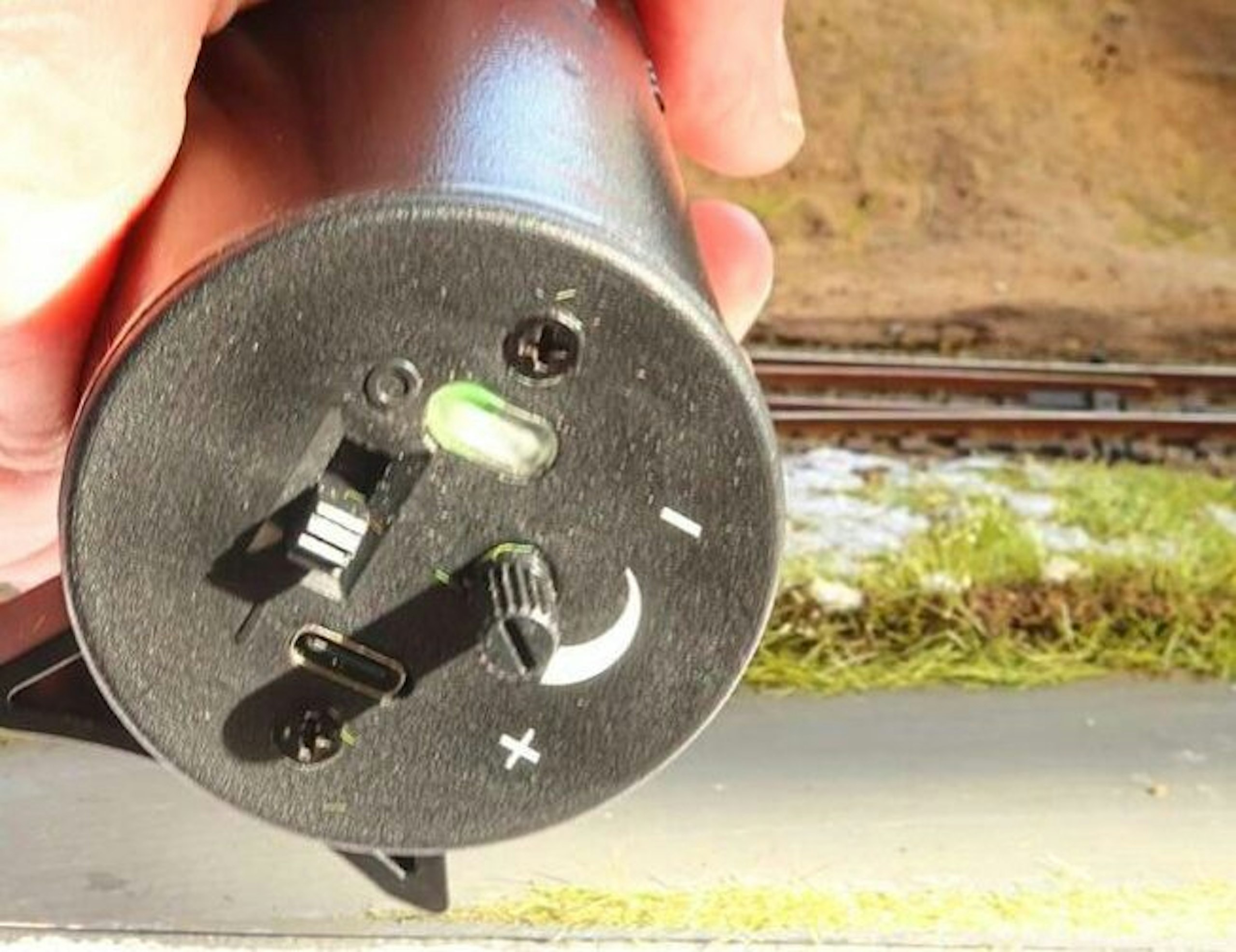
7 A green light indicates it has sufficient power available for operation. It turns red when the tool needs to be recharged. This is the PROFI tool, with adjustable power control.
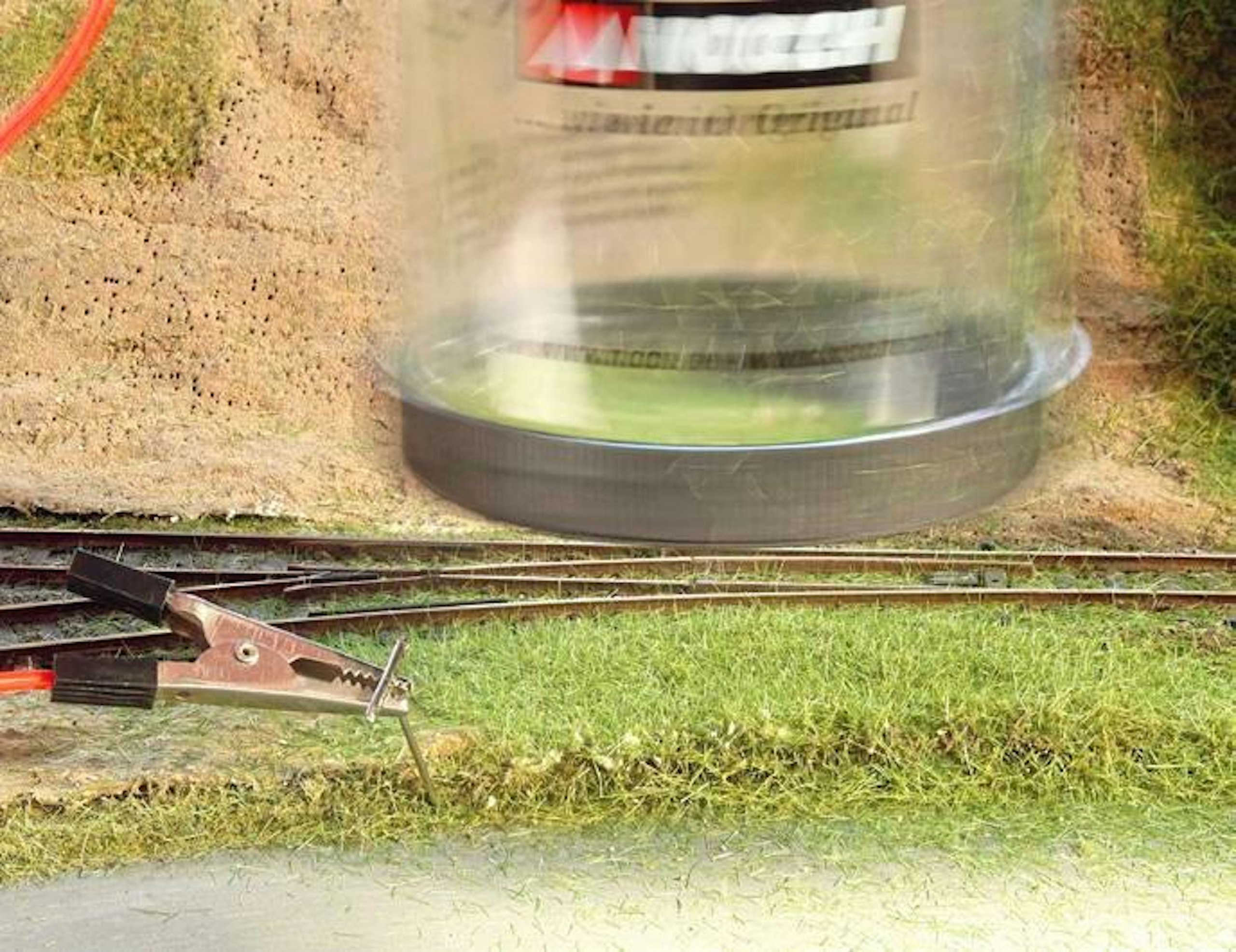
8 With the tool switched on, you gently move it over the area of wet glue, depositing the fibres into place. The electrostatic charge forces the fibres to stand upright.
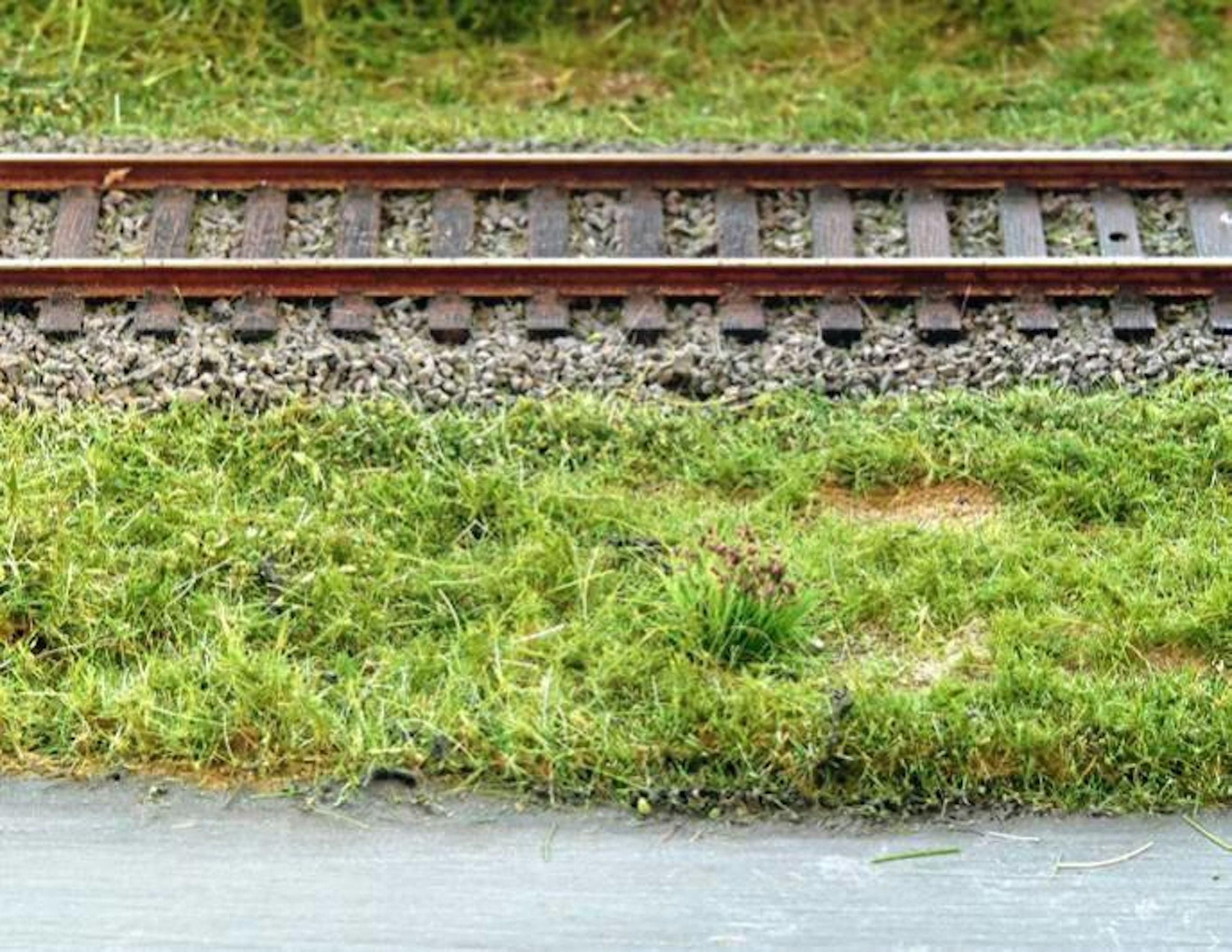
9 The finished results, showing the advantage of mixing up slightly different shades of and lengths of fibres. Building up successive layers of fibres adds even more texture.
Safety first
Electrostatic grass planting tools are not recommended for use by children under 14, and safety instructions should be studied before use. Do not touch the internal contact surfaces when the tool is switched on, and use the tool in line with the instructions, especially with regard to periods of continuous operation.
If you have an implanted electronic medical device, such as a pacemaker, it is wise to consult a doctor before operating an electrostatic grass planting tool due to the strong electromagnetic field created.
Full operating and safety manuals for each tool can be downloaded for free from the Noch website, www.noch.com
PETER’S VERDICT
PROS
● Several worthwhile improvements for both tools, especially the ability to recharge them rather than buy new batteries.
● The carry case for the PROFI tool is handy for storing the tool and its accessories safely.
● Excellent all-round performance.
CONS
● Cheaper grass planting tools are available.
● Buying additional grass fibre containers will increase costs.
● Having the power switch on the base of the tool takes some getting used to.
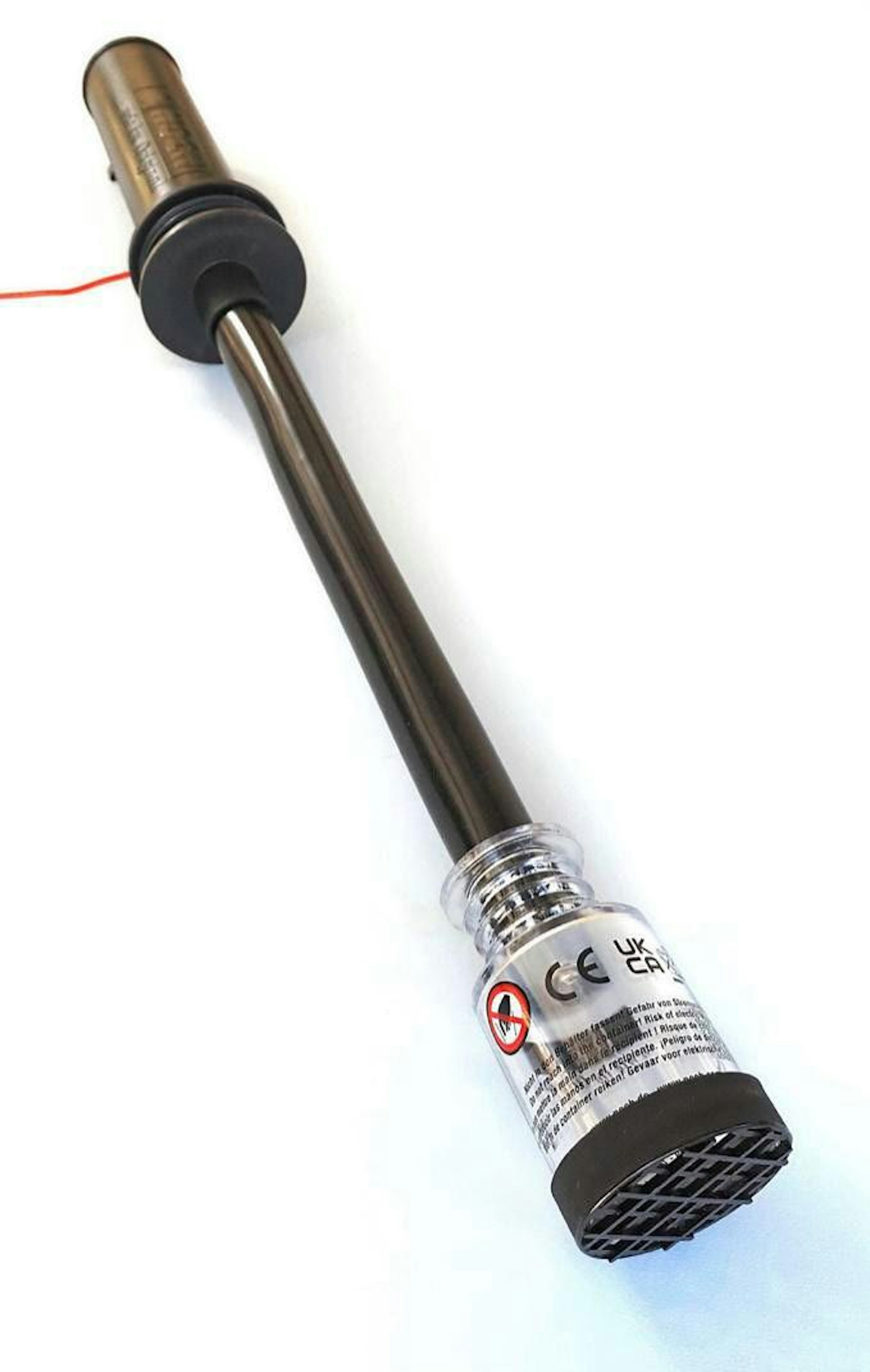
The Detail Flocker, supplied with the 4.0 PROFI versions, is a long, flexible extension to the Gras-Master, ideal for reaching into tight spots on a layout. It’s also available as an optional extra for the Gras-Master 4.0.
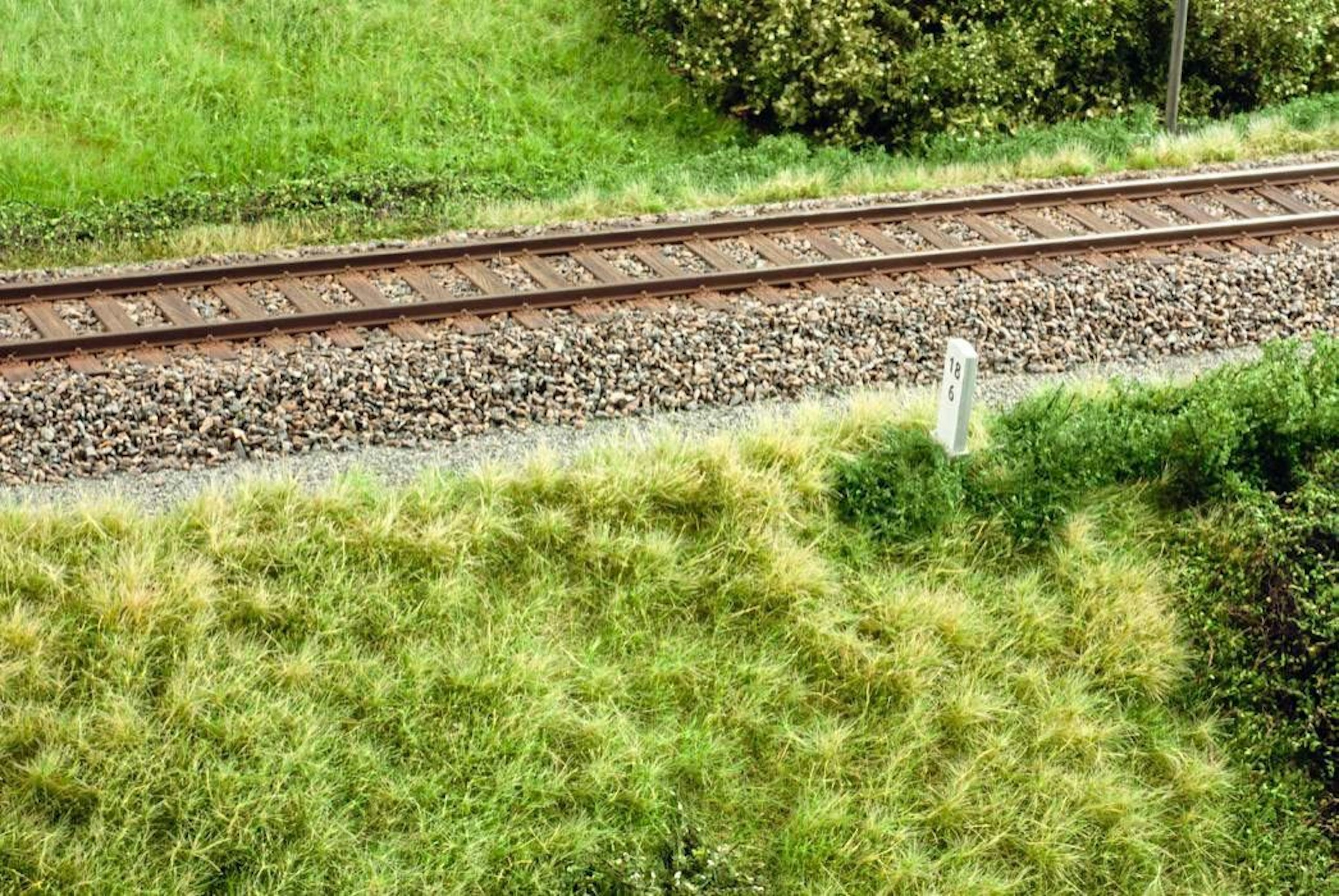
Noch’s first Gras-Master tool arrived in 2005 and transformed the model scenic landscape, making it easier to achieve lifelike results.
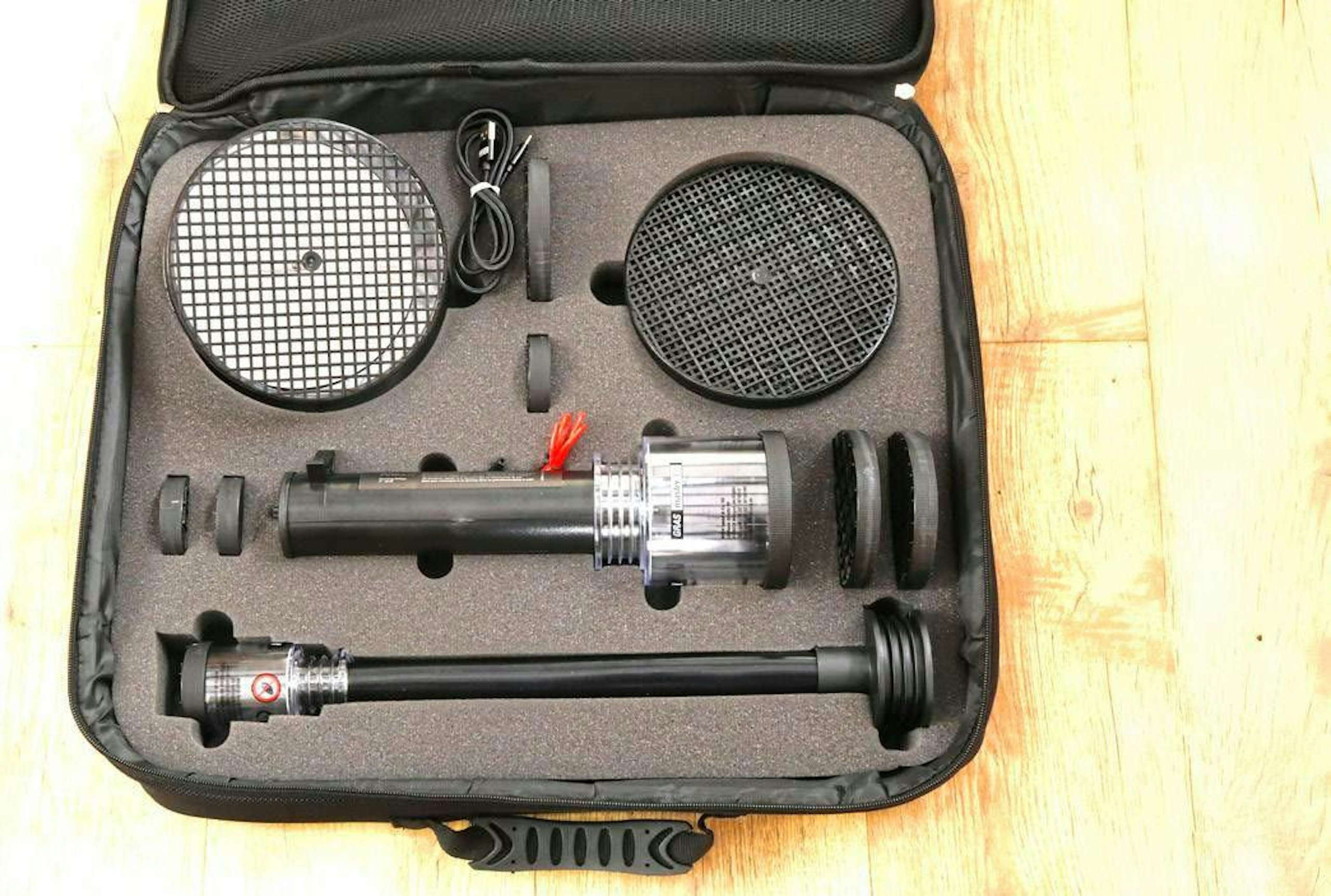
The new Noch Gras-Master 4.0 PROFI package comes in a handy bag and comes complete with a range of accessories, including a Detail Flocker attachment, interchangeable fibre containers and various sieve filters.
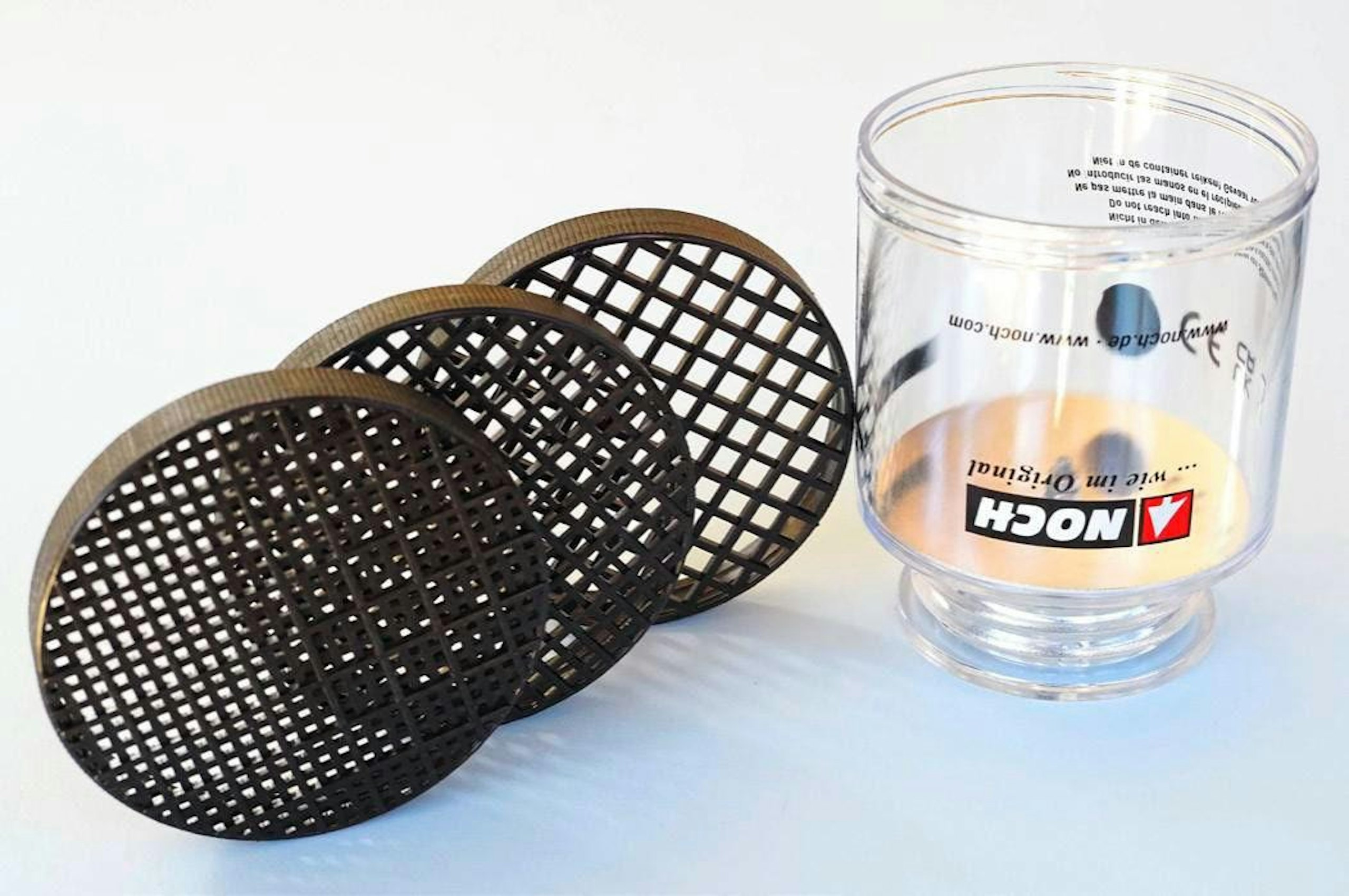
The separate, interchangeable fibre containers allow them to be filled away from the tool and the clear material makes it clear when a refill is needed.
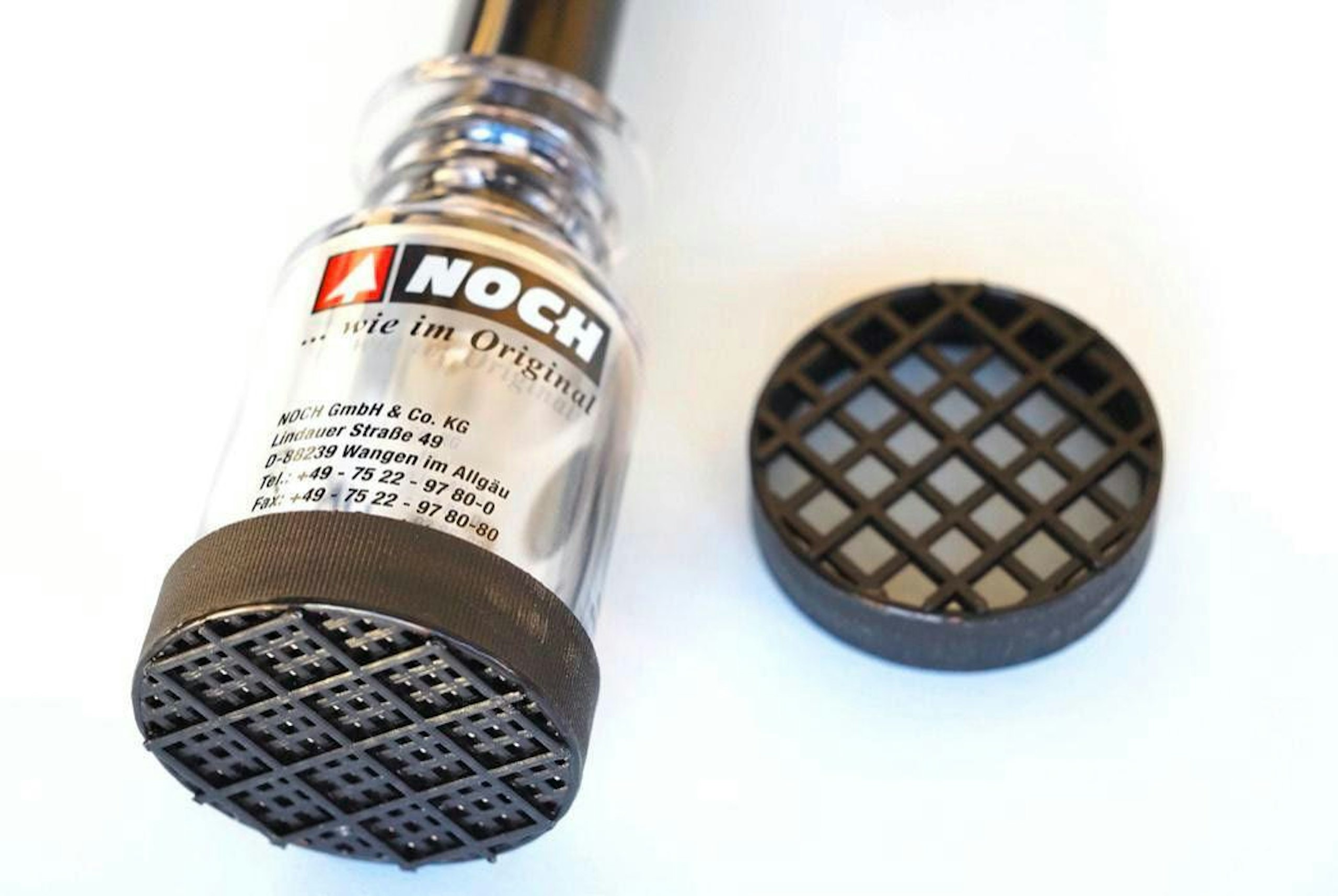
Different sieve filters can be swapped over to suit different fibre lengths and prevent clumping of the material as it leaves the tool.
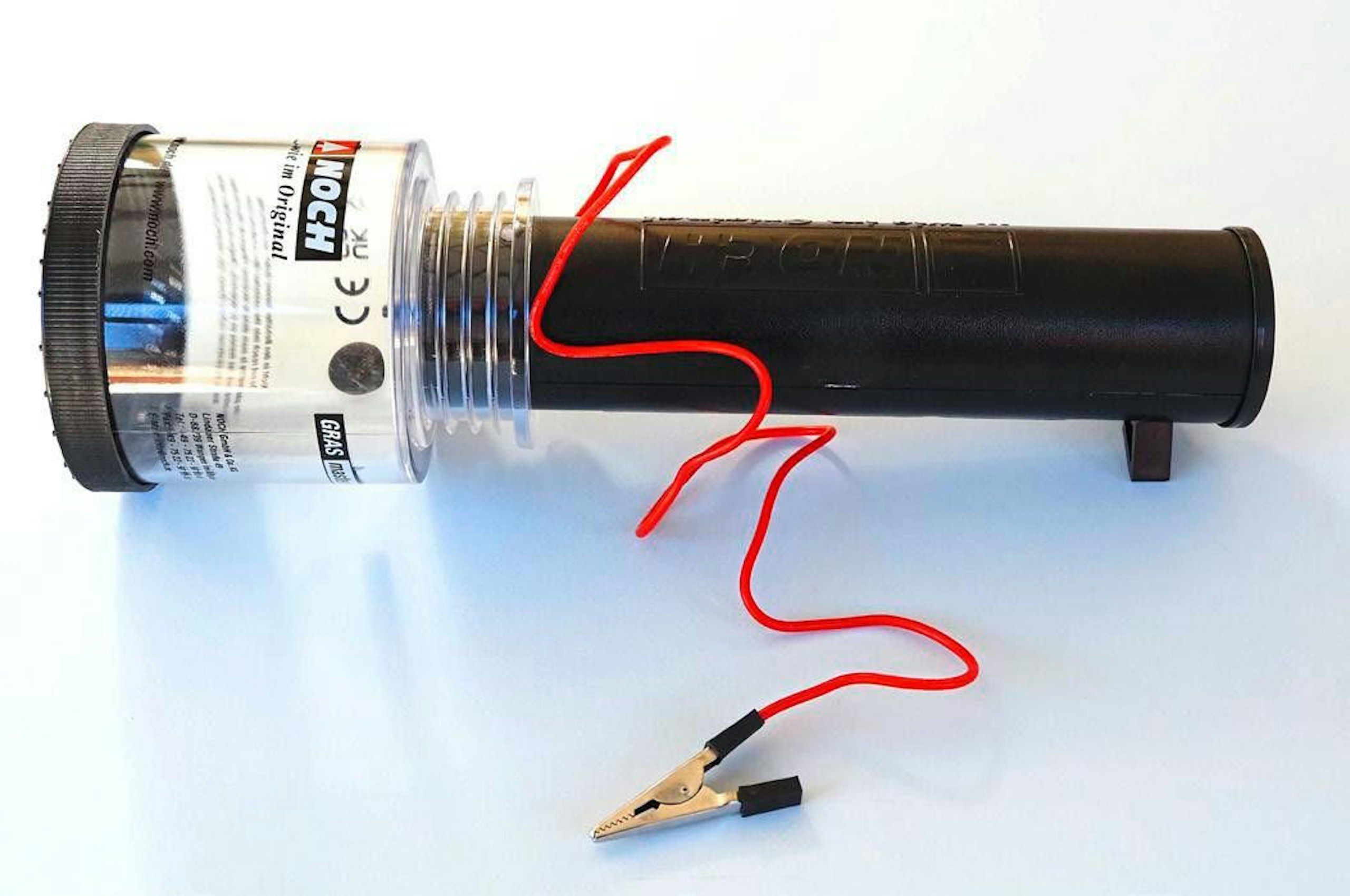
Noch released its latest Gras-Master 4.0 tool in 2025, which does away with the need for separate batteries in favour of a USB-charged power pack. Note the convenient stand incorporated into the handle to prevent it rolling onto the floor (it happens!).
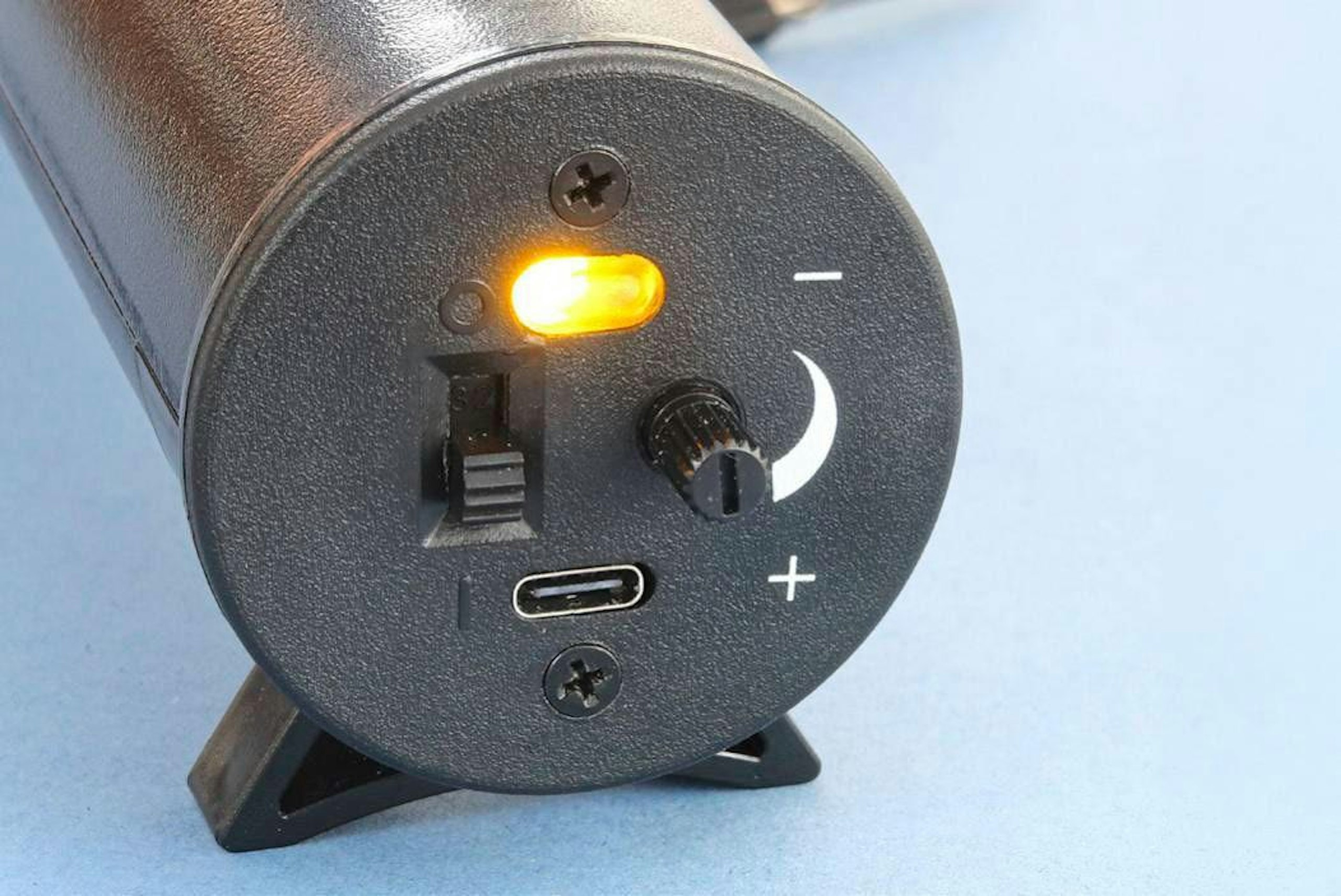
Featuring an adjustable voltage control, the output of Noch’s Gras-Master 4.0 PROFI can be tailored to suit the size and quantity of grass fibres to be planted.
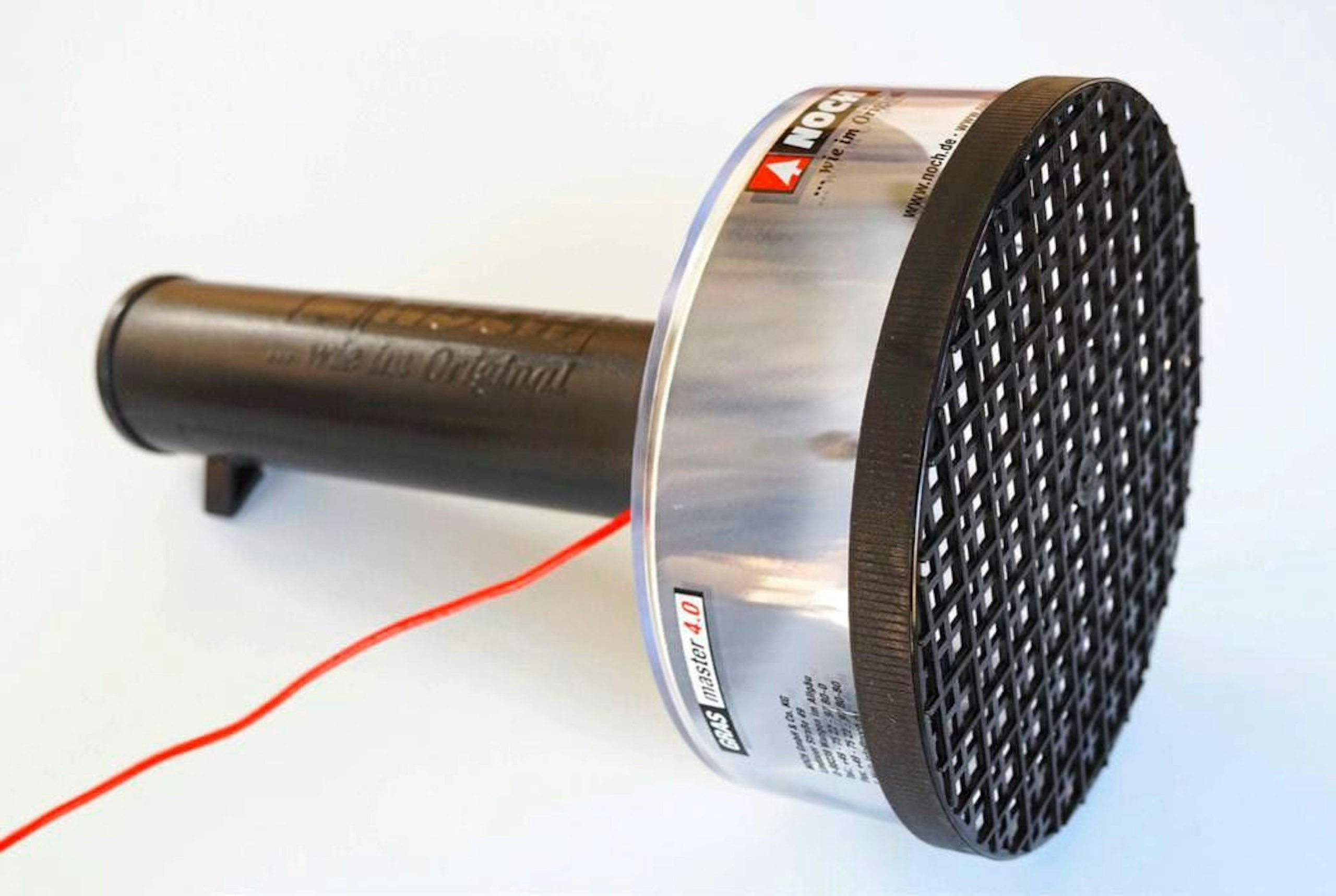
The XL container, supplied with Gras-Master 4.0 PROFI and optional for the regular 4.0 tool, is perfect for treating wide open spaces and farm fields.
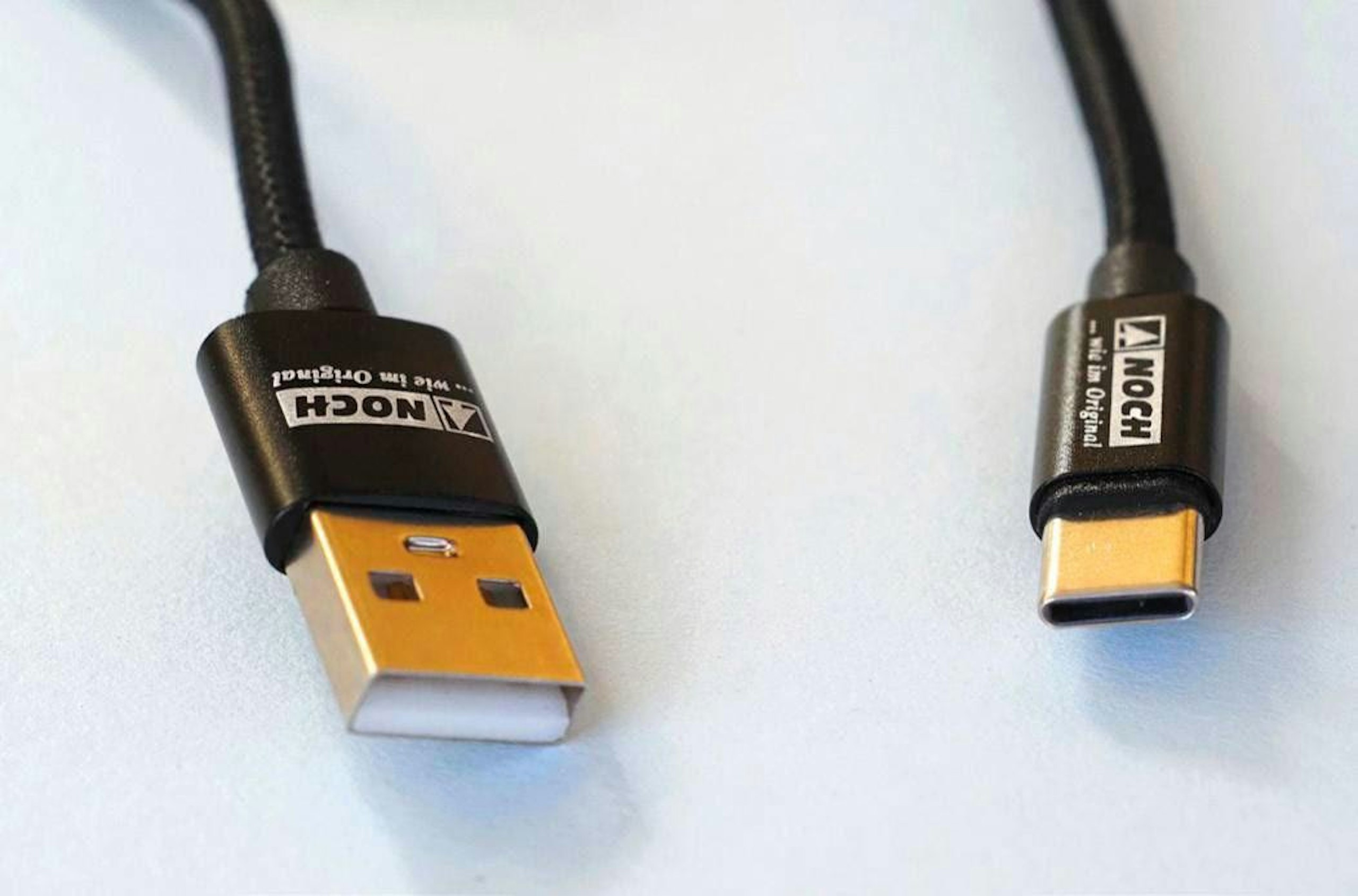
Both new tools are supplied with USB charging cables and take up to 4 hours to restore to full power once the power has run out. LED status lights help the user know how much ‘juice’ remains.
Subscribe to a Model Rail Print+ Subscription today and you'll get instant digital access, PLUS FREE UK delivery so you will never miss an issue.